How to Solve a Sliding Puzzle
Here is how to solve a sliding puzzle of any size with a single method: finish the top row, then the left column, repeat on what is left, and turn the last block into place.
Before you start: check that it can be solved
If the puzzle is one you built yourself or took apart, check first that it can be solved at all. Exactly half of all arrangements are impossible, and no amount of sliding fixes them. If a board will not come out after a long try, enter it in the sliding puzzle solver. It tells you whether the position is reachable and, if so, how to finish it.
A scramble that comes from legal slides is always solvable. Leadlight scrambles from a finished window, so every puzzle in the game can be solved.
The one move you have, and what it costs
All you can do is slide a tile next to the gap into the gap. In Leadlight you can tap a pane further along the same row or column and it carries every pane in between. That feels like one gesture but counts one move per pane, so a tap that slides three panes costs three moves. Keep that in mind when you are chasing par.
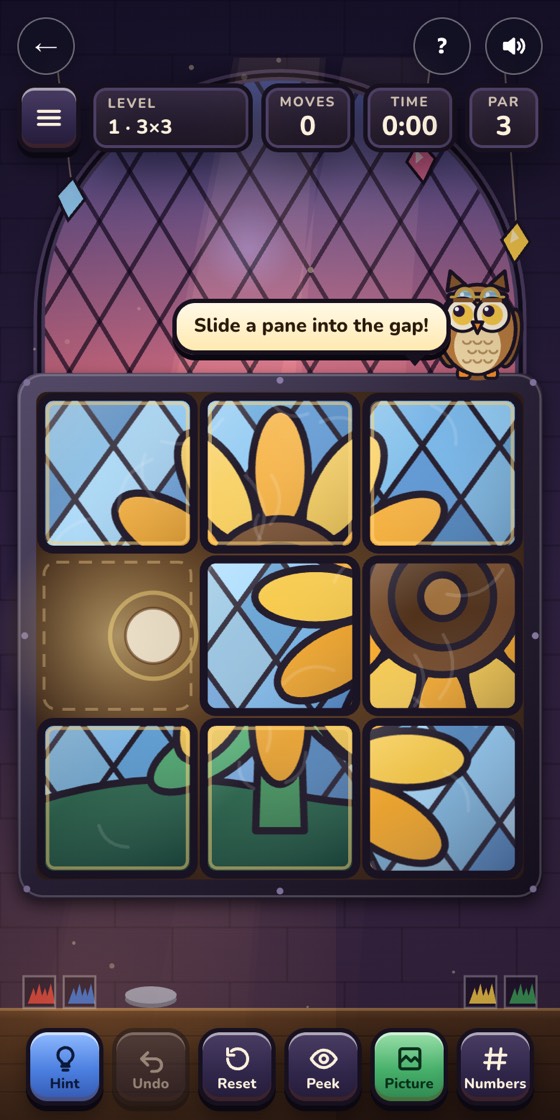
How to solve a sliding puzzle in four stages
The method works on every size, from 3×3 to 6×6, and it is the one beginners can learn quickly. The idea is to finish the board from the outside in and never disturb the part you have finished. The goal is the tiles in reading order with the gap in the bottom right corner, or the whole picture rebuilt.
Stage 1: build the top row
Place the tiles one by one from the left. Tile 1 goes in the top left corner, tile 2 next to it, and so on. Each one is easy, because you have the whole rest of the board to move around in.
The last tile of the row is the tricky one, because the finished tiles box it in. Use this trick. Put the last tile of the row in the square where the second-to-last tile belongs, and put the second-to-last tile directly below it. Then bring the gap to the top right corner of the row. Slide the last tile right into its place, then slide the second-to-last tile up. Both tiles land together.
On a 3×3 board the row is 1, 2, 3. Put 3 where 2 belongs, put 2 under it, move the gap to the top right corner, then slide 3 right and 2 up.
Stage 2: build the left column
Turn your attention to the leftmost column of what is left, and fill it from the top in the same way. The last tile of the column has the same problem, and the same trick works when you turn it sideways: put it in the second-to-last square of the column, put the previous tile beside it, and slide both home. Leave the finished row alone while you do this.
Stage 3: repeat on the smaller square
Each pair of stages removes one row and one column, leaving a smaller square. A 5×5 board becomes 4×4, then 3×3, and so on. Do the top row, then the left column, of whatever is left. Do not go back for tiles you have already placed.
Stage 4: rotate the last 2×2 block
When only a 2×2 block is left, it holds three tiles and the gap. Circle the gap around the block, and the three tiles turn like a wheel. Keep going until they sit in order. On a board that can be solved they always do, because a 2×2 block can only turn in a circle.
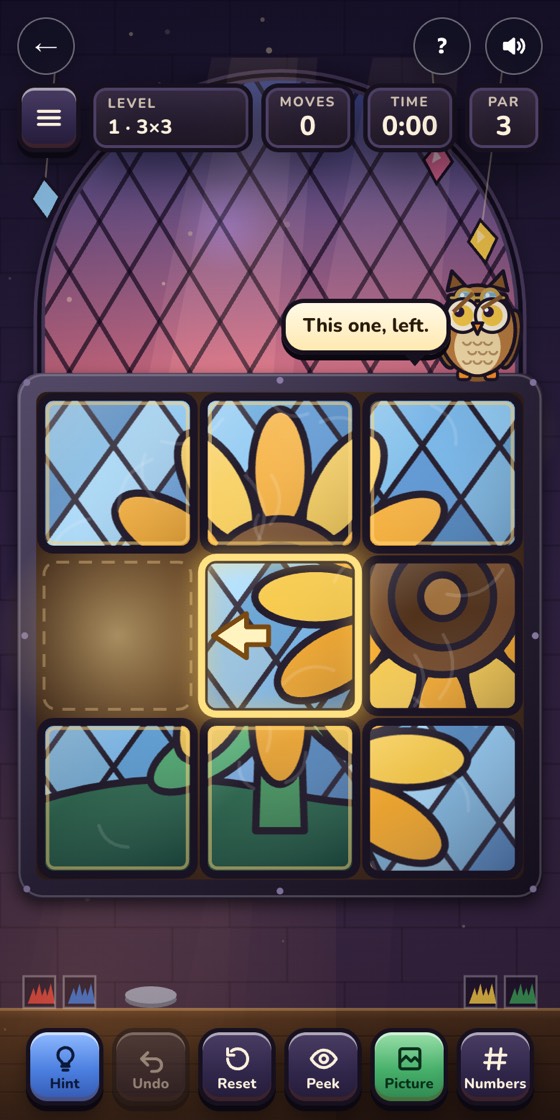
Tips that make it easier
- Number the pieces. On a busy picture, switch Numbers on in Leadlight so every pane has a number on the glass.
- Use Peek. It shows the finished window for about a second and a half, so you can check where a pane belongs.
- Do not undo solved rows. A tile placed by Stage 1 is worth more than a short cut that disturbs it.
- Work out two moves ahead when the gap is next to the tile you want, and bring the gap to the far side of the tile first.
- Count moves, not seconds. Par is the length of the shortest solution the game found, and stars depend on how close you get.
The method versus the shortest answer
The four stages are reliable, but they are not the shortest route. The hardest 3×3 board needs 31 moves at best. In Leadlight, the row-by-row method solves the same board in 39. That gap is why par exists, and why a built-in solver is worth a look after you finish: enter your starting board and compare its shortest answer with yours.
Practise on real boards
Free play in Leadlight lets you pick a size and a picture, from 3×3 up. The daily scramble adds three new boards a day (Easy 3×3, Medium 4×4, Hard 5×5), each with a par to beat. Start with a 3×3 until the top-row trick feels natural, then step up to 4×4, which is the classic 15 puzzle.
Common questions about solving
- What is the easiest way to solve a sliding puzzle?
- Build the board from the outside in: top row, then left column, then repeat on the smaller square, and finish with the last 2×2 block. Each stage leaves the finished tiles alone.
- Does the same method work for 3×3, 4×4 and 5×5?
- Yes. Only the number of repeats changes. A 5×5 board takes two more rounds of row and column than a 3×3 board.
- How do I place the last tile of a row?
- Put it where the second-to-last tile belongs, put the second-to-last tile directly below it, bring the gap to the end of the row, then slide the last tile right and the other one up.
- Why can I not finish my puzzle?
- If it was taken apart and rebuilt, it may be one of the arrangements that cannot be solved: exactly half of them are. Enter it into the solver on this site to find out.
- Is there a shortest way to solve it?
- There is for a 3×3 board, and a search can find it. The most any solvable 3×3 needs is 31 moves. Hand methods are longer, and nobody is expected to find the shortest answer by eye.
Stuck on a board right now? The sliding puzzle solver checks it and shows the moves. Or play a fresh puzzle on the home page.